Scalp Micropigmentation vs Scalp Shading | SMP Guide
Last updated: 4 Sept 2026
389 Views
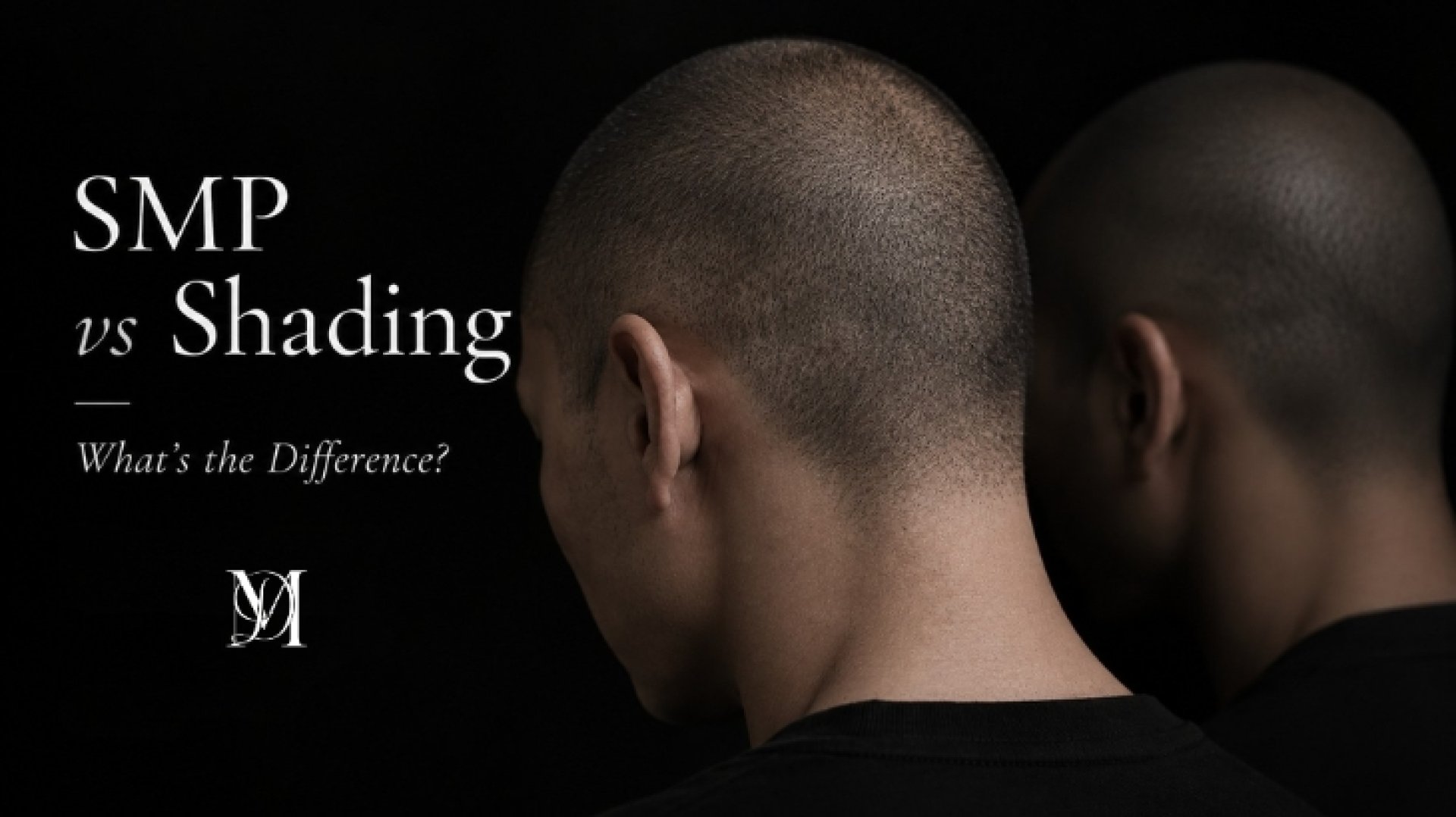
Are There Different Types of Hair Tattoo? What’s the Difference Between Scalp Micropigmentation and Scalp Shading?
If you’re wondering about the difference between scalp micropigmentation (SMP) and simply adding or shading pigment across the scalp,
here’s the easiest way to understand it:
Scalp micropigmentation = creating tiny dots that mimic the appearance of real hair follicles or shaved hair stubble.
Scalp shading = adding more pigment to the scalp to reduce the visual contrast between the hair and the exposed skin.
Although both can fall under what people commonly search for as a hair tattoo or scalp tattoo,
the way the finished result looks can be very different.
With Scalp Micropigmentation (SMP), tiny Micro Dots are placed across the scalp to create texture that resembles natural hair follicles.
A more shading-focused approach, on the other hand, relies more heavily on adding color to the scalp so that areas of thinning hair appear less exposed.
So which one should you choose?
If your goal is a result that still looks like individual hair follicles or stubble even when viewed up close,
we generally place more emphasis on the Micro Dot technique.
But there’s something important to understand first:
Those tiny dots may look simple, but creating natural-looking ones is much more technical than it seems.
Scalp Micropigmentation Is Not Just “Dotting the Scalp Until It Looks Full”
Think about someone who has just shaved their hair very short.
What you see on the scalp isn’t a solid dark surface. You see thousands of tiny points where the hair follicles and very short hair stubble are visible.
That is what scalp micropigmentation is designed to imitate.
It may sound simple. Why not just create lots of dots until the area looks full?
Because if every dot is the same size, the same darkness, evenly spaced and arranged too perfectly,
the result can begin to look like a pattern rather than natural hair follicles.
On the other hand, if too many dots are packed closely together with very little space between them, they can visually merge.
What should look like individual hair stubble can start to look like an area of solid pigment.
That is why good SMP requires more than simply knowing how to make dots.
An experienced artist also needs to understand where pigment should be added — and where it should stop.
Why Does Some SMP Look Like Real Hair While Other Work Looks Like a Tattoo?
There isn’t one single reason.
Natural-looking scalp micropigmentation is created by many small technical decisions working together.
These include the size of the Micro Dots, hand pressure, pigment depth, pigment tone, spacing between dots and the overall density of the work.
For example, an artist may intend to create a very small dot, but if the pigment is deposited too heavily or at an inappropriate depth for the skin,
that dot may not heal exactly as it looked immediately after the procedure.
Or imagine that every individual dot looks beautiful, but the overall density is too high.
When you step back and look at the entire scalp, those individual dots may visually blend together and create an area that appears darker than the surrounding hair.
So when we perform SMP, we aren’t only asking:
“Does this dot look good?”
We also have to ask:
“What will happen when hundreds or thousands of these dots are placed together?”
This is where an artist’s experience becomes especially important.
Does Darker Pigment Make Hair Look Thicker?
This is a common assumption among people considering a hair tattoo or scalp micropigmentation.
If the hair is dark, it may seem logical to choose a very dark pigment so the area looks fuller.
But in practice:
Darker doesn’t automatically mean more natural.
The artist needs to consider the client’s natural hair color, skin tone and the density of the existing hair.
If the natural hair is relatively thin but the SMP underneath is very dark and dense,
the pigmentation itself may become more noticeable than the actual hair.
At Madam Studio Bangkok, when we assess an SMP case, we don’t only ask:
“How dark does the client want it?”
We also consider:
“What level of pigment will actually blend with this person’s existing hair?”
Because the goal isn’t simply to make the scalp darker.
The goal is to make the area appear to have more hair density.
Those are two very different things.
So Is Scalp Shading Wrong?
Not necessarily.
The important point is that the visual approach is different.
Adding pigment to the scalp can reduce the contrast between darker hair and lighter exposed scalp.
From a certain distance, this can make areas of thinning hair appear less visible.
But the next question is:
What does it look like up close?
With scalp micropigmentation, where the goal is to recreate the appearance of hair follicles or stubble, we want the Micro Dots to remain visually distinguishable rather than blending into one solid block of color.
Those tiny spaces between individual dots matter.
They help the eye interpret what it sees as:
“Many individual hair follicles.”
Rather than:
“One area of pigment on the scalp.”
So it isn’t simply about one method being “right” and another being “wrong.”
The more useful question is:
What kind of result do you want to see?
If Your Hair Is Thin, Why Not Make the SMP as Dense as Possible?
Because scalp micropigmentation has to work with the real hair you already have.
Imagine someone with thinning hair around the crown.
If we create extremely dense SMP in that area while the surrounding natural hair remains relatively sparse,
the treated area may become darker than everything around it.
Instead of blending in, it can create a new area that stands out.
This is why density is so important.
From the hair tattoo and SMP cases we see at Madam Studio Bangkok, one of the things we need to assess carefully is how much natural hair
the client still has and how that hair is distributed.
Two clients may both say:
“My hair is thinning.”
But their situations can be completely different.
One person may still have plenty of hair, but the strands are fine enough that the scalp shows through.
Another may have significantly fewer hair strands, leaving larger visible areas of scalp.
Both may want scalp micropigmentation to make their hair look fuller,
but the density and placement of the Micro Dots should not automatically be the same.
SMP Doesn’t Have to Look Completely “Full” After the First Session
Some clients come in for a hair tattoo and naturally want to see the biggest possible difference immediately.
That’s understandable.
But with SMP, gradually building density in layers can give the artist more control over the final result.
The pigment you see immediately after a session and the appearance of the pigment after the skin has healed are not necessarily identical.
If too much density is packed into the first session, there may be less flexibility to adjust the overall appearance later.
Starting with an appropriate foundation and gradually adding detail where needed allows the result to be built more deliberately.
With scalp micropigmentation, the question isn’t always:
“Is it full enough?”
A better question is:
“Does the density look right with the client’s real hair?”
Can You Get Scalp Micropigmentation If You Still Have Hair?
In many cases, yes.
You do not necessarily need to be completely bald to consider SMP.
For clients who still have hair but have areas where the scalp is clearly visible —
such as along a widening part or in areas of reduced density — Micro Dots can be placed between the existing hairs to create more visual density.
Think of it this way:
If the hair is dark and the exposed scalp underneath is much lighter, the contrast makes the gaps between the hair easier to see.
When carefully designed Micro Dots are added between those hairs, the eye sees more texture and the exposed scalp may become less visually prominent.
However, one thing is especially important:
The SMP should not become more noticeable than the client’s real hair.
This is particularly important for clients with longer hair.
Today you may part your hair in the middle.
Tomorrow you may part it to the side.
Some days you may tie it up.
Other days your hair may be wet.
The scalp micropigmentation underneath should still make visual sense in everyday life,
not only when the hair has been styled perfectly for a before-and-after photograph.
What If There Is No Hair in the Area at All?
Then the approach changes.
When natural hair is still present, much of the work involves blending Micro Dots with what already exists.
When an area has little or no hair and the goal is to recreate the appearance of shaved hair stubble,
the artist has to think more carefully about the entire visual structure.
This becomes especially important around the hairline.
A natural hairline is not usually a perfectly straight, solid line.
If the first row of SMP is extremely dense and sharply defined, the hairline can quickly appear artificial.
Creating a natural-looking SMP hairline therefore involves careful transitions in density.
The edge may begin softer before gradually becoming denser farther into the scalp.
Sometimes the most natural-looking result doesn’t come from making everything perfectly symmetrical.
It comes from understanding where things should not look too perfect.
Does Scalp Micropigmentation Make Hair Grow?
The short answer is:
No.
A hair tattoo or scalp micropigmentation does not create new hair growth.
SMP uses pigment to recreate the visual appearance of hair follicles and increase the perception of density on the scalp.
If you have a certain number of real hairs before SMP, the procedure itself does not increase that number.
What changes is how noticeable the spaces between those hairs appear.
That is why it is important to separate SMP from treatments intended to address the underlying cause of hair loss.
If you are experiencing sudden, unusual or unexplained hair loss, the cause of that hair loss should be assessed separately.
Scalp micropigmentation changes the visual appearance of the scalp; it does not regrow hair.
Before Choosing an SMP Artist, Do One Thing: Look at the Work Up Close
Before-and-after photographs taken from a distance are useful because they show the overall transformation.
But if you really want to understand the quality of scalp micropigmentation, look at close-up photographs too.
Zoom in and ask:
Can you still see individual Micro Dots?
Do the dots look too large or blurred?
Are they packed so closely that they merge into one area?
Do they form an obvious pattern?
How does the treated area transition into the client’s natural hair?
Then step back and look at the overall result again.
From a normal viewing distance, the hair should appear fuller.
Up close, the pigmentation should still retain the visual character of hair follicles or stubble.
Good SMP has to work at both distances.
Up close, the details matter.
From a distance, it should blend with the real hair.
So Which Should You Choose: Scalp Micropigmentation or Scalp Shading?
If your main goal is simply to reduce the contrast between your scalp and your hair, adding pigment to the scalp can create one type of visual effect.
But if your goal is to create texture that resembles individual hair follicles or shaved hair stubble,
a Micro Dot-based scalp micropigmentation technique is more aligned with that result.
However, seeing the word “SMP” on a service menu does not mean the results will be identical everywhere.
The final appearance depends on details such as:
Dot Size / Depth / Pressure / Pigment / Spacing / Density / Layering / Gradient / Blending
These are the details that determine whether thousands of tiny dots eventually look like:
“hair stubble”
or
“pigment on the scalp.”
Scalp Micropigmentation at Madam Studio Bangkok, Silom Bangkok
At Madam Studio Bangkok, our approach to scalp micropigmentation focuses on creating Micro Dots
and designing the density to work with each client’s existing hair.
Before starting, we don’t look only at the area where the client says:
“My hair is thin here.”
We look at the overall picture.
What color is the natural hair?
How dense is the existing hair?
Where is the scalp most visible?
How should the new SMP transition into the natural hair?
And what kind of visual change is the client hoping to achieve?
From there, the pigment, dot size, spacing, density and transitions can be planned according to the individual case.
We don’t want to use the same pattern on every scalp.
Someone with long hair and a widening part, someone with very short hair, someone with an area
of significant hair loss and someone looking to recreate a hairline may all be searching for the same thing:
“hair tattoo” or “scalp micropigmentation.”
But the way each case should be designed can be very different.
Madam Studio Bangkok provides Scalp Micropigmentation (SMP) and hair tattoo services on Silom Road in central Bangkok.
Clients can begin with a consultation and assessment of their existing hair and the area of concern to understand whether SMP
is suitable for the result they want and how the treatment may be designed for their individual case.
Scalp Micropigmentation vs Scalp Shading: The Simplest Way to Remember the Difference
If there is only one thing you remember from this article, make it this:
Scalp Micropigmentation = the eye should see “hair follicles and stubble.”
Scalp Shading = pigment is used primarily to reduce the visual appearance of exposed scalp.
With Micro Dot-based SMP, one tiny dot may seem insignificant.
But once thousands of those dots work together across the scalp, their size, darkness, spacing and density all affect one another.
So before choosing a hair tattoo or scalp micropigmentation treatment, don’t only ask:
“Will my scalp look darker?”
Ask:
“When I look at the finished result, does it look like pigment was added to the scalp — or does it look like hair stubble that naturally belongs there?”
For us, the second question matters much more.
Because the goal of natural-looking scalp micropigmentation is not to make people notice that you had SMP.
It is to make the overall area appear fuller, while allowing the work itself to quietly blend into the hair that is already there.
Related Content
Thinning hair or visible scalp? Scalp Micropigmentation gives a fuller look instantly without surgery, with natural-looking results.

Hairline tattooing or scalp micropigmentation (SMP), is a technique that mimics natural hair strokes or tiny hair follicles using safe pigments.
What’s the difference between hairline and dot tattoos? Find out who should choose which — Not sure what to choose? Madam explains!

